INDRBT / Reading room
Audit of the requested digital scope
Adapted for browser reading from the project’s illustrated documentation. Numeric results and engineering scope are unchanged. Reproduction notes are optional; the robot and board viewers run from the navigation above.
On this page
This audit compares the supplied master brief with the implemented project. It separates required digital deliverables from optional extensions and performance claims that the brief explicitly excludes. The final integrated workflow reports DIGITAL SCOPE COMPLETE only after its recorded tests, executed native schematic/PCB checks and a freshly verified versioned wheel pass on the current source revision. The subsequently requested PCB layout and native DRC are completed and documented. Repository and release publication are verified separately through the public GitHub repositorySource file and latest versioned releaseSource file. The project-purpose guide connects the artifacts to the original goals.
Numerical and software deliverables
| Master sections | Requested deliverable | Implemented evidence | Scope conclusion |
|---|---|---|---|
| 14–17, 35–36 | Six-axis FK, bounded numerical IK, Jacobian, singularities, joint limits, tests and measured reconstruction errors | Kinematic formulation, src/robotarm/kinematics, 60 perturbed-seed trials, tests/test_kinematics.py |
Required digital work is present. IK is local numerical search, not exhaustive solution enumeration. |
| 18, 32 | Seeded workspace sampling, projections, 3D view and conditioning plots | Workspace metrics, samples and workspace/frame figures | Required outputs are present. Hull and voxel values are labelled envelope/sampling proxies, not certified reachable volume. |
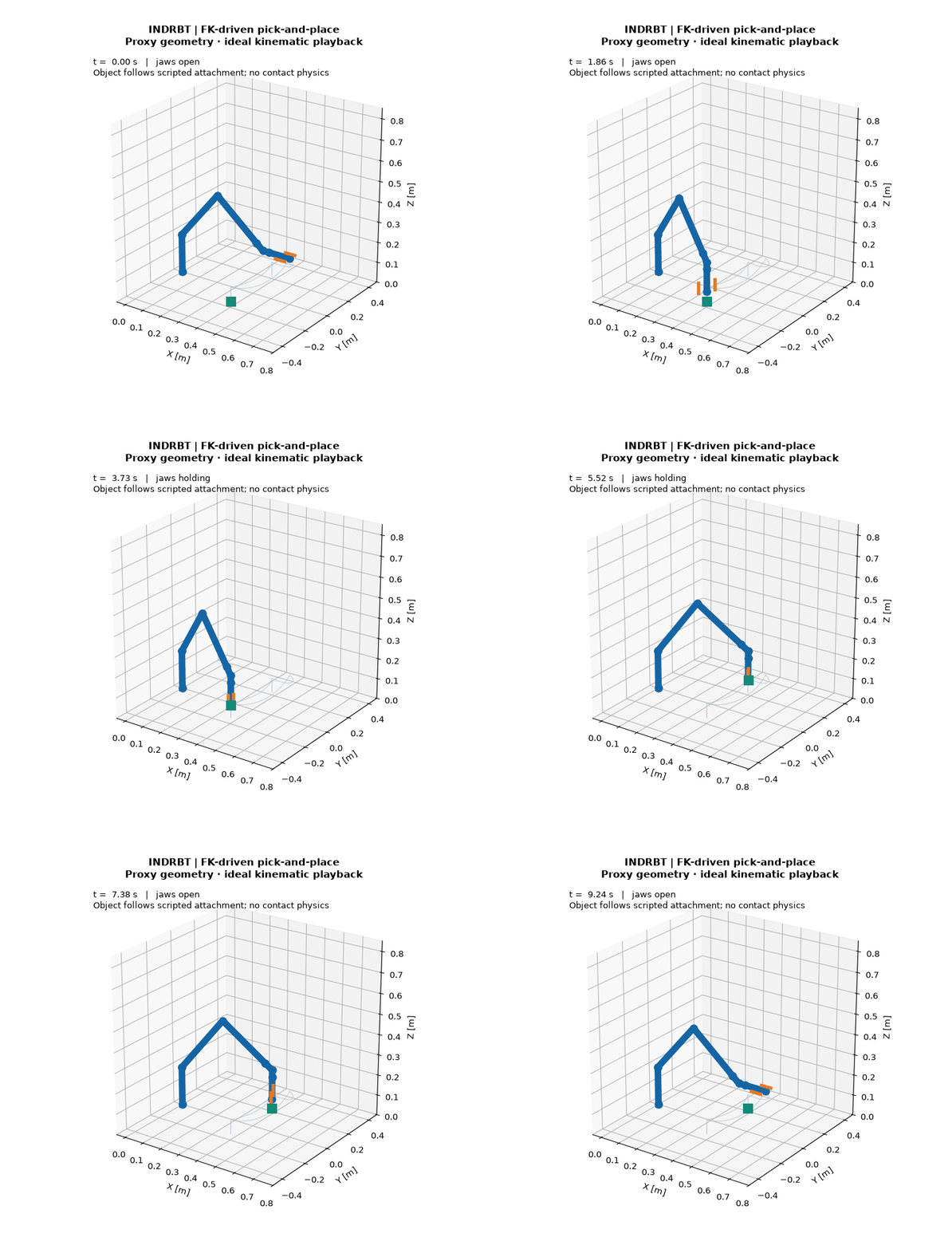
| 19–21, 33 | Linear/cubic/quintic planning, MOVE J, approximate MOVE L, pick/place task and model-driven animation | src/robotarm/planning, src/robotarm/simulation, trajectory metrics, task data, FK GIF, CAD twin |
Required motion demonstration is present. Linear interpolation is a constant-speed interior; rest-to-rest task segments use quintic laws. MOVE L bounds are checked at samples. |
| 22 | Symmetric gripper range, travel, force and actuator torque calculations | src/robotarm/gripper, tests/test_gripper.py, mechanical analysis |
Required digital mechanism and calculations are present. Force is calculated from assumed efficiency and friction, not measured. |
| 23–25, 44–45 | Static load/torque, structure calculations, conceptual actuator sizing, numerical experiments and KPIs | analysis/, mechanical results, five research sweeps, KPIs |
Required analyses are present. Simplified analytical beams are an expressly permitted alternative to full FEA. |
| 26–27 | PID step response, tracking, error curves and optional controller comparison | src/robotarm/control, tests/test_control.py, step/tracking metrics, two control figures |
Required PID work is present, including saturation and antiwindup. P/PI/PD/PID modes exist; a comparative controller study is optional. |
| 30–31, 34–35, 57–60 | Organized Python package, central SI parameters, commands, meaningful tests and one validation workflow | src/robotarm, SI configuration, python -m robotarm.demo, scripts/run_validation.py, executed reportSource file |
The report records actual totals without failures, errors or skips. Current source and authoritative-input hashes bind its revision. Full regeneration refreshes CAD, numerical results, native CAD/render/clearance proof and native ERC/DRC/connectivity before acceptance. |
| 56, 59 | Reproducible setup, clean installation and portable execution | Installation instructions, setup.py, MANIFEST.in, requirements-lock.txt, scripts/verify_wheel_install.py, isolated wheel evidence |
The versioned wheel is installed in a new isolated environment and executed outside the source tree. Every installed/wheel module and the bundled configuration are compared with source; FK/IK, planner/gripper, fresh CLI outputs and dependencies are checked. |
Executed integration gates and publication evidence
The numerical/control/software audit found no additional missing required deliverable. The routed PCB, fabrication exports, updated descriptions and traceability, integrated validation and fresh versioned installation checks now have executed evidence. The PCB audit records 44 schematic footprints plus four mechanical additions, all 119 physical pad-net assignments checked, and zero native DRC violations, unconnected items or schematic parity issues. Hashes bind the source board and exported files.
Sections 51–52 require the coherent repository, tag and release assets. Their publication evidence is the live repository and versioned release, including the complete organized ZIP and installable wheel. Local digital acceptance covers the executed engineering checks; it cannot substitute for live publication verification. Passing checks retain their exact enabled-rule and sampling scope; changing status text cannot replace evidence.
The original section 11 asks to check obvious interference throughout representative configurations; the project's SIM-003 requirement also specifies representative screening. The initial selected-pair checks missed genuine adjacent-joint overlaps. Those interfaces were repaired and the representative audit was expanded: six named poses classify 8,586 component pairs, and 75 task configurations classify 107,325 pairs; exact BRep intersection counts are retained in the current clearance report. Rigid-family contacts are explicitly classified, and open/mid/closed gripper states are checked separately. This verifies the stated representative screening, not every possible joint combination or the continuous sweep between samples. Its limitations remain explicit. A stronger collision-certification requirement would need to come from an additional user instruction or newly adopted requirement.
Limits that do not imply an unfinished digital brief
| Limitation | Master brief treatment | Accurate completion treatment |
|---|---|---|
| No physical robot, measured payload rating or measured repeatability | Sections 1, 4, 45 and 62 explicitly make this a digital project and distinguish targets from physical measurements | Keep payload/force/repeatability as TARGET or assumption-based calculation. Do not require a physical build to complete the digital project. |
| Analytical beam models instead of full CAD FEA | Section 24 explicitly permits analytical calculations when full FEA is impractical | Retain stress/deflection simplifications and omitted joint/cutout/compliance effects. Full FEA remains future work. |
| Independent inertia/damping PID plants instead of coupled rigid-body dynamics | Section 26 requires a simplified digital joint-control model | The implemented model satisfies this scope; coupling, gravity, backlash and drive delays remain declared extensions. |
| Scripted object attachment instead of friction/contact physics | Sections 21 and 33 require a simulated task and motion corresponding to the kinematic model | Describe the demonstration as ideal kinematic pick/place. Do not claim contact or gripping validation. |
| Sampled approximate Cartesian motion and a geometric workspace | Sections 18 and 20 request numerical sampling and basic approximately linear TCP motion | Preserve sample/solver limitations; do not imply a collision-free operating envelope or continuous-time certificate. |
| No production firmware, manufacturing tolerances, EMC/thermal certification or functional-safety certification | Sections 28–29 define conceptual digital electronics; no hardware is built | Retain these as engineering limitations, separate from completion of the requested digital artifacts. |
| Extra controller comparisons or circular Cartesian motion | Sections 20 and 27 make these conditional enhancements | Their absence is not a missing required deliverable. |
The executed local status is DIGITAL SCOPE COMPLETE — digital educational engineering project. The current release records coherent, reproducible completion of that documented digital scope. The repository, tag and assets provide separate publication evidence. This status does not imply a manufactured, hardware-ready or safety-certified robot; intentionally excluded physical validation remains outside the completed digital brief.