INDRBT / Reading room
Understand the engineering.
Digital engineering model. Payload and repeatability are design targets. All ordinary guide reading, figures and PDFs work here. Links marked Source file lead to the public engineering repository.
Follow one original six-axis robot from solid geometry to a useful task, load calculations, feedback control and a concrete interface board. Begin with the visual walkthrough; open the deeper chapters only where you want more detail.
01 / The connected storyHow INDRBT worksGeometry → kinematics → motion → loads → control → electronics.02 / Mechanical designArm, tool and gripperActual solids, six poses, meaningful interfaces and dimensioned drawings.03 / Circuit and PCBFollow power and signalsRead the schematic, component references, board layers and check evidence.04 / The equationsUnderstand the mathematicsTransforms, IK, Jacobian, planning, beams, gripper work balance and PID.
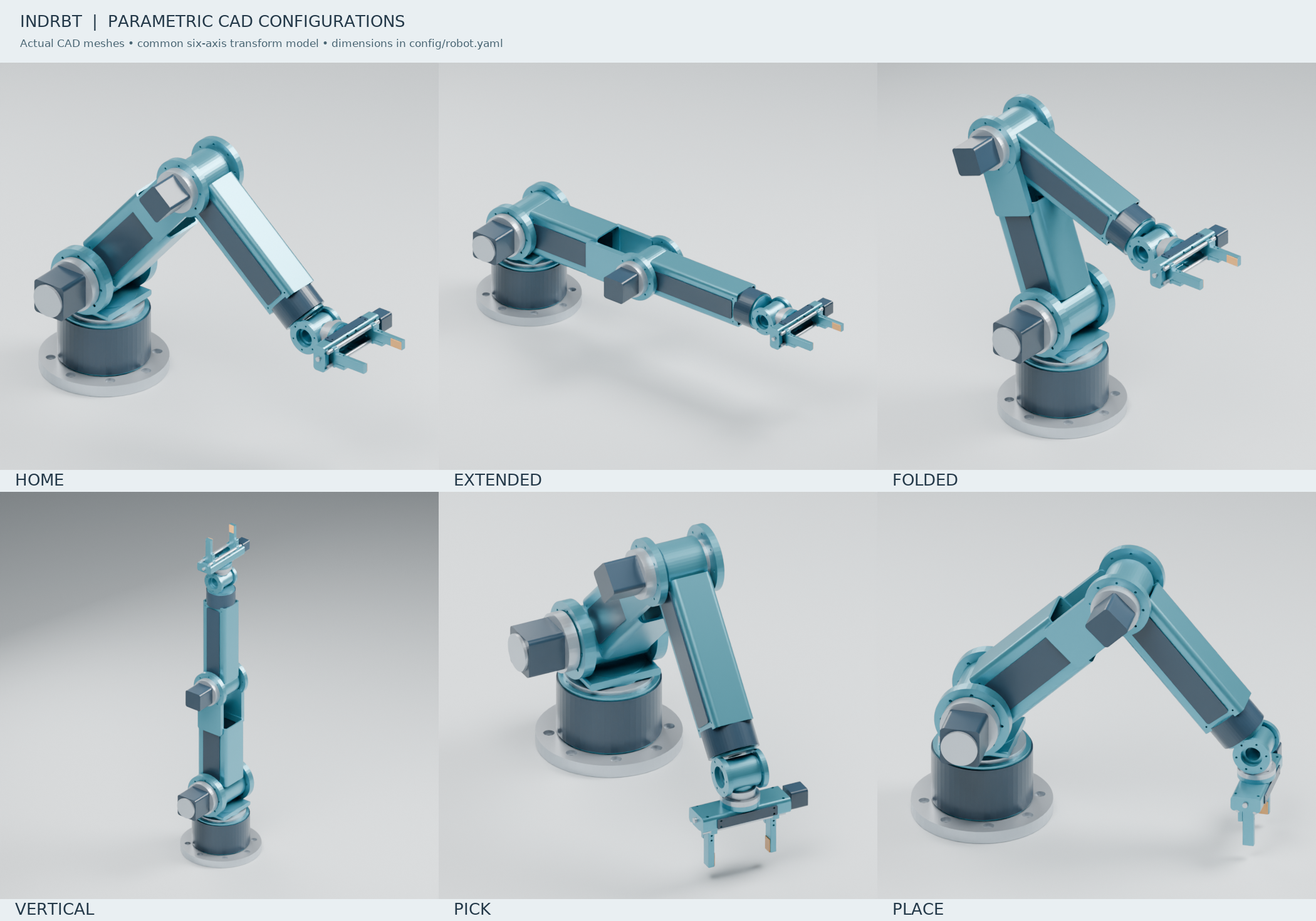
A clear reading route
- Purpose and original goals — see the question connecting the subsystems.
- Engineering walkthrough — read the task as one connected engineering story.
- Full theory guide — work through units, equations and their interpretation.
- Engineering report — review design decisions, generated results and limitations.
- Evidence index — inspect the retained calculations and native check records.
Find a chapter
| Subject | Read here |
|---|---|
| Requirements and system | Requirements · Architecture · Purpose |
| Frames and motion | Kinematics · Recorded task |
| Mechanics and CAD | Loads, structure and drive sizing · CAD method · Part catalog |
| Electronics | Design chapter · Component guide |
| Results and verification | KPIs · Requirements matrix · Final review · Scope audit |
| Engineering process | Choices and tradeoffs · Actual project journal · Optional source reproduction |
Read claims with their evidence class
TARGET is desired performance; ASSUMED is a model input; CALCULATED and SIMULATED are model outputs; VERIFIED DIGITALLY identifies an executed check. The 4 kg payload and ±0.1 mm repeatability remain targets. Sampled clearance, simplified PID and conceptual electronics do not establish physical qualification.